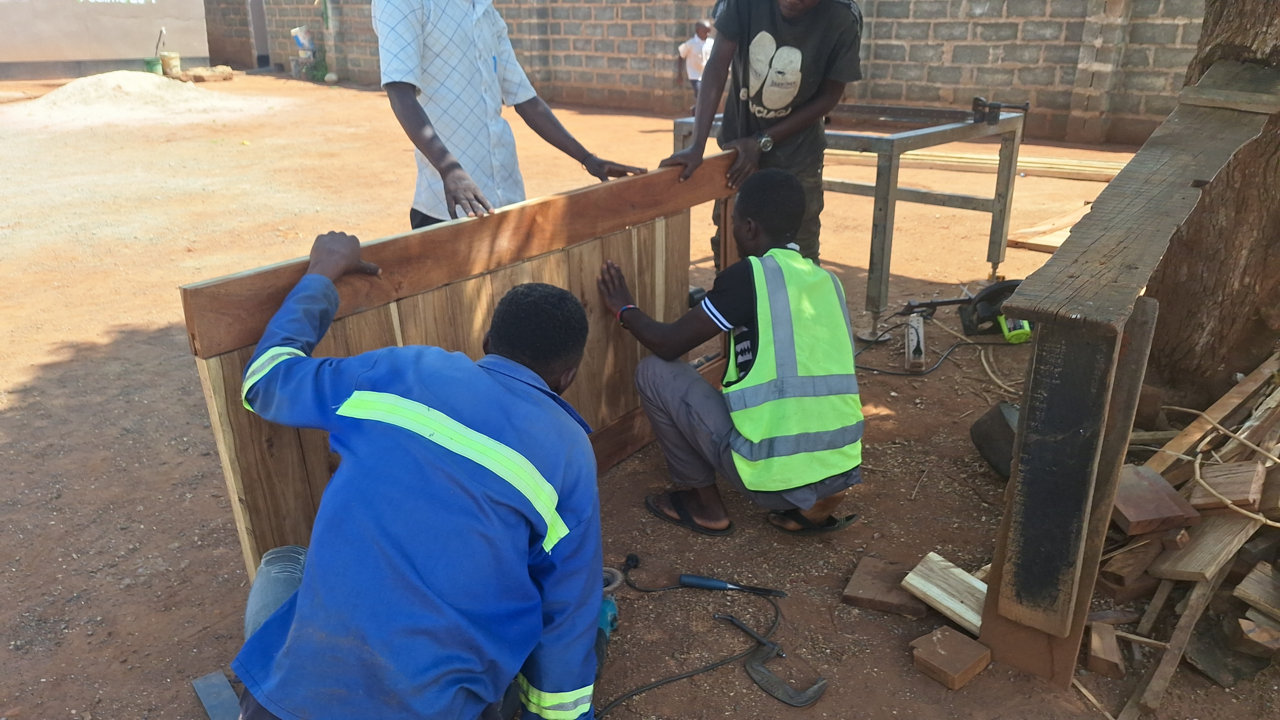
At the All Is Grace campus, young men take part in hands-on carpentry training as part of a skills development program. The photograph on this page shows participants working together on a wooden structure using basic tools in an outdoor workshop area.
The training focuses on practical tasks. Participants measure, cut, assemble, and secure wood under supervision. The work is physical and methodical, emphasizing technique, safety, and repetition rather than speed or output.
Many of the young men involved in the program come from backgrounds marked by limited educational access and disrupted pathways into adulthood. For some, formal schooling was interrupted, and opportunities to learn a trade were not available earlier in life. Skills training provides an alternative route for learning that does not rely on classroom instruction alone.
Learning takes place by doing. Participants observe demonstrations, practice techniques, and receive guidance as they work. Mistakes are corrected on site, and progress is visible in the construction itself. Confidence develops through repeated engagement with tools and materials.
Carpentry training introduces participants to a trade with practical applications. The skills learned can be used to build furniture, repair structures, and support basic construction needs within the community. The work connects effort to tangible results.
The training environment also supports shared responsibility. Participants work alongside one another, assist with tasks, and contribute to a collective project. The setting encourages cooperation and focus, shaped by the demands of the work rather than abstract instruction.
This page documents one moment within the skills training program at All Is Grace. It reflects how practical trades training is used to create structured learning opportunities for young adults seeking usable skills and a stable path forward.